









At TrustDice, the word "Trust" is not just a marketing prefix; it is our operational North Star. As we navigate the landscape of 2026, where the intersection of blockchain and iGaming has reached maturity, our understanding of Responsible Gaming (RG) has evolved. It is no longer a set of regulatory checkboxes—it is a core product philosophy.
The Paradox of Trust: Why RG Matters More in Crypto
Crypto-gaming offers unparalleled benefits: anonymity, instant payouts, and global access. However, these same features can increase the risks of impulsive behavior.
As operators, we understand that a player’s longevity is our ultimate success metric. A user who loses their balance in one night due to a lack of self-control is a failure of our ecosystem. Conversely, a user who plays within their means for years becomes a valued member of our community. RG is our primary tool for Player Lifetime Value (LTV) optimization.
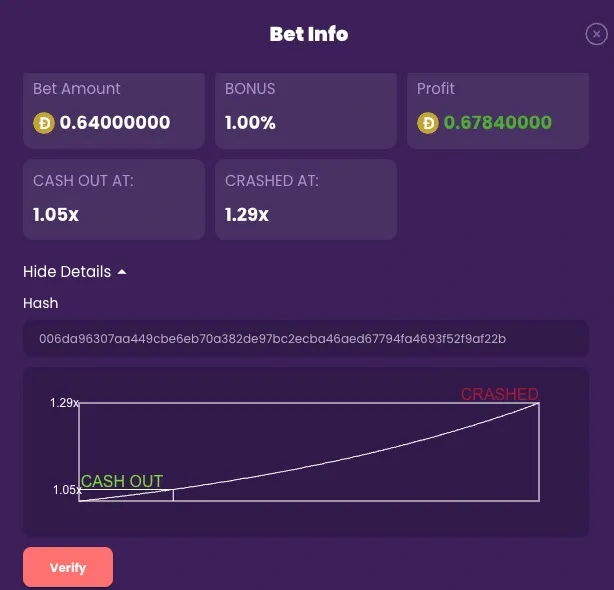
Pillar A: Transparency through "Provably Fair" Technology – Eliminating the "Rigged Game" Fallacy
One of the most dangerous psychological triggers in problem gambling is the "Rigged Game" narrative. When a player experiences a losing streak, a common cognitive distortion occurs: they believe the system is actively manipulating results against them. This often leads to "tilting"—an emotional state where the player aggressively increases their bets to "beat the cheat" or "force a win."
At TrustDice, we utilize Provably Fair algorithms as a fundamental Responsible Gaming tool to dismantle this destructive cycle.
1. The Mechanics of Trust
Unlike traditional online casinos where the Random Number Generator (RNG) is a "black box," TrustDice operates on a cryptographic verification model.
- The Hash Protocol: Before a round begins, the system generates a seed and provides the player with its hashed version. This serves as a digital "seal" that cannot be altered after the bet is placed.
- Verification: Once the result is revealed, the player can use the provided seeds to manually verify the outcome on the blockchain.
- The Impact: This eliminates the "conspiracy" element. When a player knows—and can prove—that the result was mathematically determined and untampered with, the impulse to "chase losses" out of spite or a sense of injustice is significantly diminished.
2. From "Luck" to "Probability Education"
Provably Fair technology serves as a continuous educational tool. By making the underlying math visible, we shift the player's perspective from a world of "luck and superstition" to a world of probability and house edges.
- Visualizing the Edge: When players interact with verification tools, they are subtly reminded of the $RTP$ (Return to Player) and the house margin.
- Logical De-escalation: Understanding that a losing streak is a statistical possibility within a fair system helps a player accept the loss logically rather than reacting to it emotionally.
3. Building a Foundation of "Radical Honesty"
In the crypto space, trust is the only currency that matters. By offering Provably Fair games, TrustDice takes the burden of "proving fairness" off the user and places the evidence in the open.
Operational Insight: An informed player is a safer player. By removing the mystery of the "spin," we empower our users to treat gaming as a transparent, fee-based entertainment service. We don't just ask for trust; we provide the tools for the player to verify it themselves.
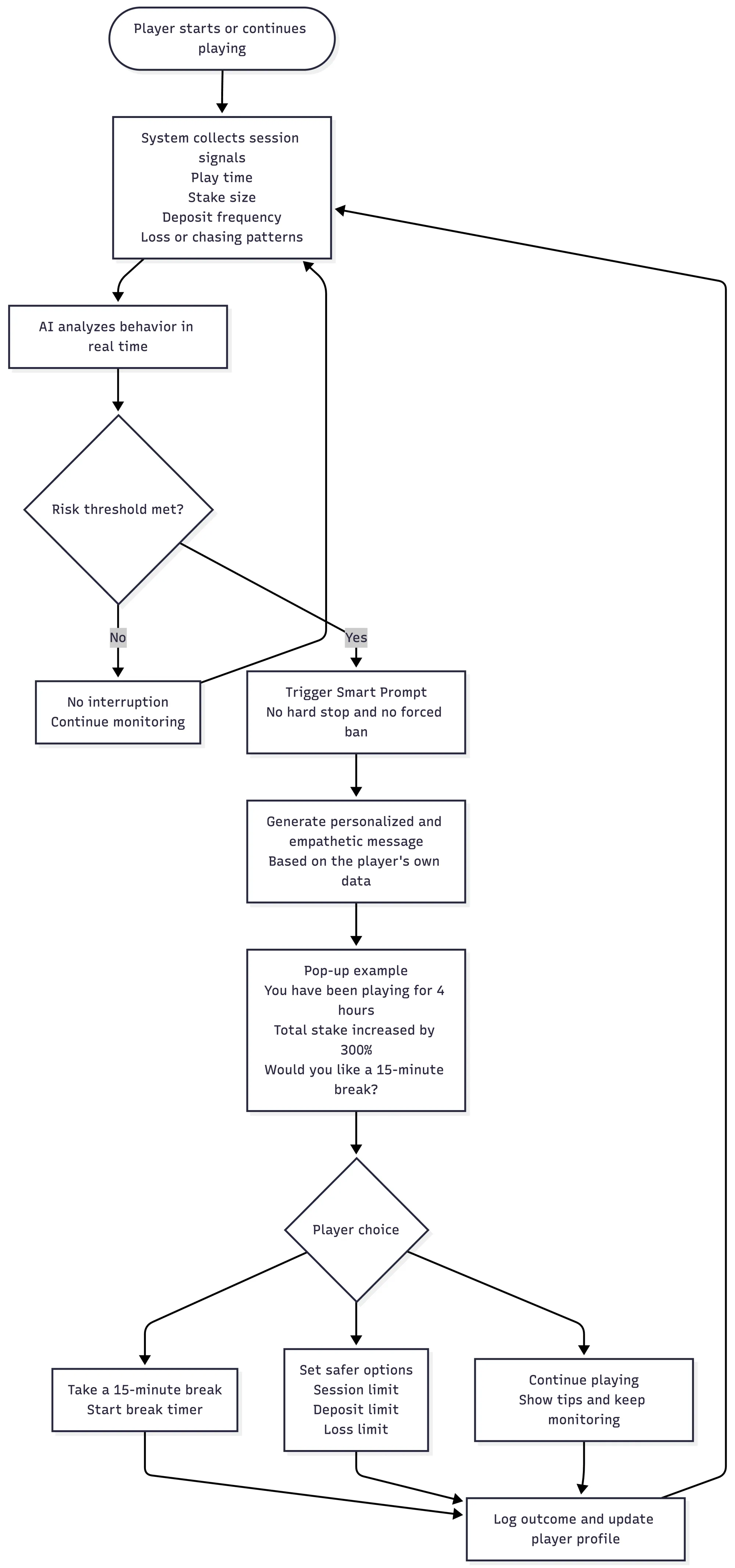
Pillar B: We Want to AI-Driven Behavioral Intervention – From Passive Limits to Proactive Protection
In the fast-paced environment of crypto-gaming, traditional "passive" tools—such as manually set deposit limits—often suffer from the "too late" syndrome. By the time a player reaches a limit, the emotional damage of a losing streak may have already set in. In 2026, TrustDice has moved beyond these static measures, implementing a Predictive AI Engine that acts as a real-time "Safety Co-pilot" for every user.
1. Deciphering the "Tilt" Signature
The core of our AI intervention is its ability to recognize "Tilt"—a state of emotional frustration where a player’s decision-making becomes irrational. Our AI doesn't just look at how much someone spends; it analyzes the velocity and psychology of the play.
- The Velocity of Desperation: The system flags accounts showing a sudden, exponential increase in bet sizes immediately following a loss (often referred to as "chase betting").
- Micro-Behavioral Shifts: We monitor patterns such as "rapid-fire clicking," erratic changes in game selection, or "marathon sessions" that exceed 8 hours without a break. These are often early warning signs of a loss of control, long before the player's balance hits zero.
- Deposit Urgency: AI detects when a player makes multiple successful (or failed) deposits in a very short window, signaling a high-risk emotional state.
2. The Science of "Proactive Friction"
Once a risk is detected, the platform introduces what we call "Healthy Friction." In modern UX design, friction is usually seen as a negative, but in Responsible Gaming, it is a life-saver.
- Smart Nudges: Instead of an aggressive ban, the AI triggers a "Smart Nudge"—a personalized, empathetic pop-up that reflects the player's own data back to them. “You’ve been playing for 4 hours and your bet size has increased by 300%. Would you like to take a 15-minute breather?”
- Dynamic Cooling-Off: If the high-risk behavior persists, the system can trigger an automated, temporary "Cooling-Off Lock." This 30-minute to 24-hour pause serves as a circuit breaker, forcing a physical and emotional disconnect from the screen.
3. Hyper-Personalized Safety Thresholds
Unlike one-size-fits-all regulations, our AI learns the "Normal Baseline" for each individual player.
- Custom Risk Scoring: A bet that is "high risk" for a casual player might be "standard" for a long-term high-roller. Our AI creates a unique behavioral profile for every TrustDice user, ensuring that interventions are accurate, relevant, and non-intrusive for those playing within their healthy limits.
- The Goal: By intervening at the moment of risk rather than after the fact of loss, we preserve the entertainment value of the platform while fulfilling our duty of care.
Pillar C: Financial Literacy & Crypto-Economic Responsibility – Navigating Volatility
Betting with BTC, ETH, or USDT is fundamentally different from betting with traditional fiat currency. In the crypto ecosystem, players face a "Double Volatility" risk: the outcome of the bet itself and the fluctuating market value of the underlying asset. At TrustDice, we believe that responsible gaming in Web3 requires a high degree of financial literacy and radical price transparency.
1. Counteracting the "Tokenization Effect"
Psychologically, it is far easier to lose track of value when betting in decimals like 0.005 BTC compared to a whole number in fiat. This "Tokenization Effect" can lead to cognitive detachment, where players no longer equate their digital balance with real-world purchasing power.
- Real-time Fiat Mirroring: TrustDice implements mandatory real-time conversion overlays. Regardless of which cryptocurrency is used, every bet, win, and loss is mirrored in the player’s chosen local fiat currency (e.g., USD, EUR, JPY).
- The "Reality Check" Anchor: By constantly anchoring crypto values to fiat, we ensure that players maintain a clear, sober understanding of their spending, preventing the emotional "gamification" of their actual wealth.
2. Portfolio Awareness and "Wallet Health"
In 2026, cryptocurrency is a major pillar of the modern user's investment portfolio. We recognize that a loss on our platform doesn't just impact a "gaming budget"—it can impact a user's long-term financial health.
- Disposable Asset Education: Our RG interface includes "Wallet Health" prompts that remind users of the importance of only utilizing disposable assets for gaming. We actively educate our community that crypto intended for long-term "HODLing" or essential savings should never be transferred to a hot wallet for betting.
- Volatility Alerts: During periods of extreme market liquidations or "flash crashes," TrustDice provides proactive alerts. We understand that market stress can lead to impulsive "revenge trading" or "panic betting," and we encourage users to step back when the broader crypto market is in turmoil.
3. Ethical Asset Management
As an operator, TrustDice views itself as a custodian of player trust within the broader Web3 space.
"Our goal is not to capture the maximum amount of a user’s crypto holdings, but to ensure that their gaming activity remains a sustainable, minor subset of their overall digital asset strategy."
By promoting financial integrity, we move away from the "predatory" labels often associated with gambling and move toward a model of sustainable digital entertainment that respects the player's long-term financial future.
From "VIP Club" to Social Responsibility
Our VIP programs, such as the VIP Club, are designed to reward loyalty, but they also carry the highest responsibility.
"True VIP management isn't about encouraging higher stakes; it's about ensuring our most active players are the most protected."
Our VIP hosts are trained not just in retention, but in behavioral health. If a high-tier player’s communication style changes or their deposit frequency spikes abnormally, our team is instructed to prioritize a "well-being check" over a promotional offer.
The 2026 Vision: A Sustainable Ecosystem
The future of TrustDice depends on a healthy, happy, and financially stable player base. We view Responsible Gaming as a competitive advantage. In an industry often clouded by scrutiny, a platform that proactively protects its users gains the most valuable currency in the crypto world: Social Proof.
Our Commitment:
- Zero Tolerance for underage gambling through enhanced decentralized KYC.
- Seamless Self-Exclusion that is respected across all our partner networks.
- Open Dialogue with our community to continuously improve our safety tools.
For TrustDice, Responsible Gaming is the "operating system" upon which our games run. By combining blockchain transparency with empathetic human intervention and advanced AI, we ensure that the dice keep rolling—safely, fairly, and sustainably.