








In the competitive world of Dota 2, your Rank and MMR (Matchmaking Rating) are more than just numbers—they represent your current skill level, match consistency, game knowledge, and long-term dedication. From new players completing their first 100 hours of unranked matchmaking to experienced veterans chasing Immortal status and leaderboard positions, understanding the Dota 2 ranking system is essential for improving your competitive performance.
This guide explains how Dota 2 ranks work in 2026, including the full medal structure, how MMR is calculated, how the Glicko-based ranking system affects calibration and rank confidence, and what the latest rank distribution data reveals about the global player base. Whether you want to know what each rank means, how much MMR you need to climb, or why your rank may change faster after inactivity or calibration, this overview gives you a clear foundation for navigating the ranked grind with confidence.
Dota 2 Ranks Explained
How Many Ranks Are There In Dota 2?
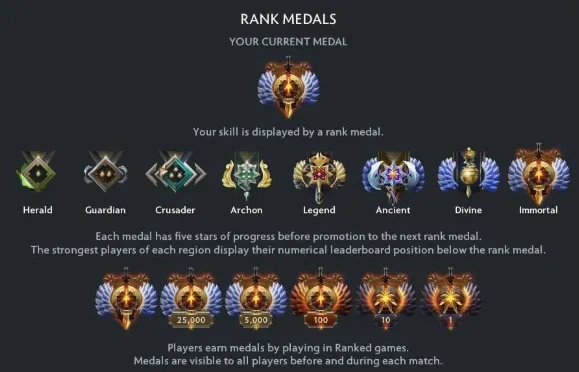
There are 8 primary rank medals in Dota 2. Each rank (except for Immortal) is divided into 5 Stars (from 1 to 5), representing progress within that tier.
- Herald
- Guardian
- Crusader
- Archon
- Legend
- Ancient
- Divine
- Immortal
What Is Matchmaking Rating (MMR)?
MMR is the numerical value hidden behind your rank medal. It serves as the primary metric for player skill.
- Skill Measurement: The higher your MMR, the better your perceived skill.
- Matchmaking Core: The system uses this number to find balanced opponents, ensuring fair play.
- Fluctuation: Generally, winning increases your MMR, while losing decreases it. The exact amount depends on the win probability of the match.
How Does the Dota 2 Ranking System Work?
The Dota 2 ranking system is designed to measure a player’s skill level as accurately as possible through MMR, rank medals, and performance consistency over time. Since the New Frontiers update, Valve moved ranked matchmaking away from the older ELO-style system and adopted a Glicko-based rating model, which gives the game more flexibility when evaluating player skill, especially after long breaks, calibration periods, or inconsistent match history.
Unlike a simple win-loss system, Dota 2 does not only look at whether you won or lost a match. The system also considers how confident it is in your current rating. This is where Rank Confidence becomes one of the most important parts of the modern Dota 2 MMR system.
1. Rank Confidence (RC)
Rank Confidence, often shortened to RC, shows how certain the matchmaking system is about your current MMR. A high Rank Confidence means the system has enough recent match data to believe your rating is accurate. A low Rank Confidence means the system is less sure about your true skill level, usually because you have not played ranked matches for a while or your recent results are highly inconsistent.
When your Rank Confidence is low, your MMR can change more dramatically after each ranked game. This is because the system is still trying to find your correct position on the ladder. As you continue playing ranked matches, your Rank Confidence increases, and your MMR gains or losses become more stable.
If your Rank Confidence drops below 30%, usually due to inactivity, your rank medal may be hidden. To make it visible again, you need to play more ranked matches and allow the system to recalibrate your rating confidence.
2. Glicko-Based MMR Changes
The Glicko system makes Dota 2 ranking more adaptive than the old fixed-rating model. Instead of treating every player’s rating as equally certain, it adds a confidence layer to your MMR. This means two players with the same visible rank may not experience the exact same MMR changes after a match.
For example, an active player with high Rank Confidence may gain or lose a relatively stable amount of MMR per game. However, a returning player with low Rank Confidence may see much larger MMR swings because the system is still reassessing their current skill level.
This helps ranked matchmaking react more quickly when a player improves, declines, or returns after a long break.
3. No Forced Seasonal Resets
Dota 2 no longer uses forced seasonal rank resets in the same way it did in the past. Instead of making every player recalibrate automatically, the system now allows players to manually recalibrate their MMR once per year through the game settings.
This gives players more control over their ranked progression. If you believe your current MMR no longer reflects your real skill level, you can choose to recalibrate. However, recalibration should be used carefully, because it can lead to faster rating movement in both directions depending on your results.
Overall, the current Dota 2 ranking system is built around three key ideas: your MMR, your rank medal, and the system’s confidence in your rating. To climb consistently, players need not only to win games, but also to maintain regular ranked activity, improve decision-making, and build stable performance across multiple matches.
How Do You Unlock Ranked Matches?
To prevent smurfing and boosting, Valve has implemented strict requirements for entering Ranked Mode:
- 100 Hours of Playtime: Must be completed in Unranked matches.
- Phone Link: You must link a unique mobile number to your Steam account.
Calibration Matches
Once unlocked, you enter the Unranked state for calibration. You must play matches until your Rank Confidence reaches 30%. This typically takes 10 to 30 matches, with each match adding roughly 1–3% RC.
What’s Special About Immortal Rank?
Reaching Immortal changes the game entirely:
- Regional Leaderboards: You receive a specific rank number indicating your position in your region.
- Immortal Draft: For matches with 8,500+ MMR, the system introduces a draft where two captains pick their teammates, emphasizing strategy and communication.
- Requirements: To stay on the leaderboard, you need at least 300 lifetime matches and 14 ranked games in the last 21 days in the same region.
Latest Dota 2 Rank Distribution (2025-2026)
Based on recent data from STRATZ.com, here is how the player base is distributed:
| Rank Medal | MMR Range (Estimated) | % of Total Players |
|---|---|---|
| Herald | 0 - 769 | ~7.2% |
| Guardian | 770 - 1539 | ~14.5% |
| Crusader | 1540 - 2309 | ~24.1% (Largest Group) |
| Archon | 2310 - 3079 | ~22.4% |
| Legend | 3080 - 3849 | ~15.8% |
| Ancient | 3850 - 4619 | ~9.3% |
| Divine | 4620 - 5420 | ~5.2% |
| Immortal | 5420+ | ~1.5% |
How To Rank Up Fast
- Master 5-6 Heroes: Don't play everything. Specialize in heroes with high impact, such as those with split-pushing or solo-kill potential.
- Review Your Replays: Watch your deaths. Identify positioning errors and learn from your losses rather than just queuing again.
- Hire A Coach: Professional guidance can help you break bad habits and understand high-level macro play much faster.
Elevate Your Experience with Dota 2 Betting
For many fans, the excitement of Dota 2 extends beyond the game client. If you have a deep understanding of the meta and rank distributions, you can put that knowledge to the test on various platforms.
When looking for a reliable place to engage with the scene, TrustDice stands out as a premier choice for fans worldwide. Whether you are looking for Dota 2 betting markets for the next Major or exploring the wider world of esports betting, TrustDice offers a seamless experience.
Why choose TrustDice?
Beyond competitive odds, they offer Instant withdraw options using cryptocurrency, ensuring you have control over your winnings immediately. They provide 24/7 support and a secure environment for all users.
Please gamble responsibly. Must be 18+. Check the site's T&Cs and local regulations before participating.