






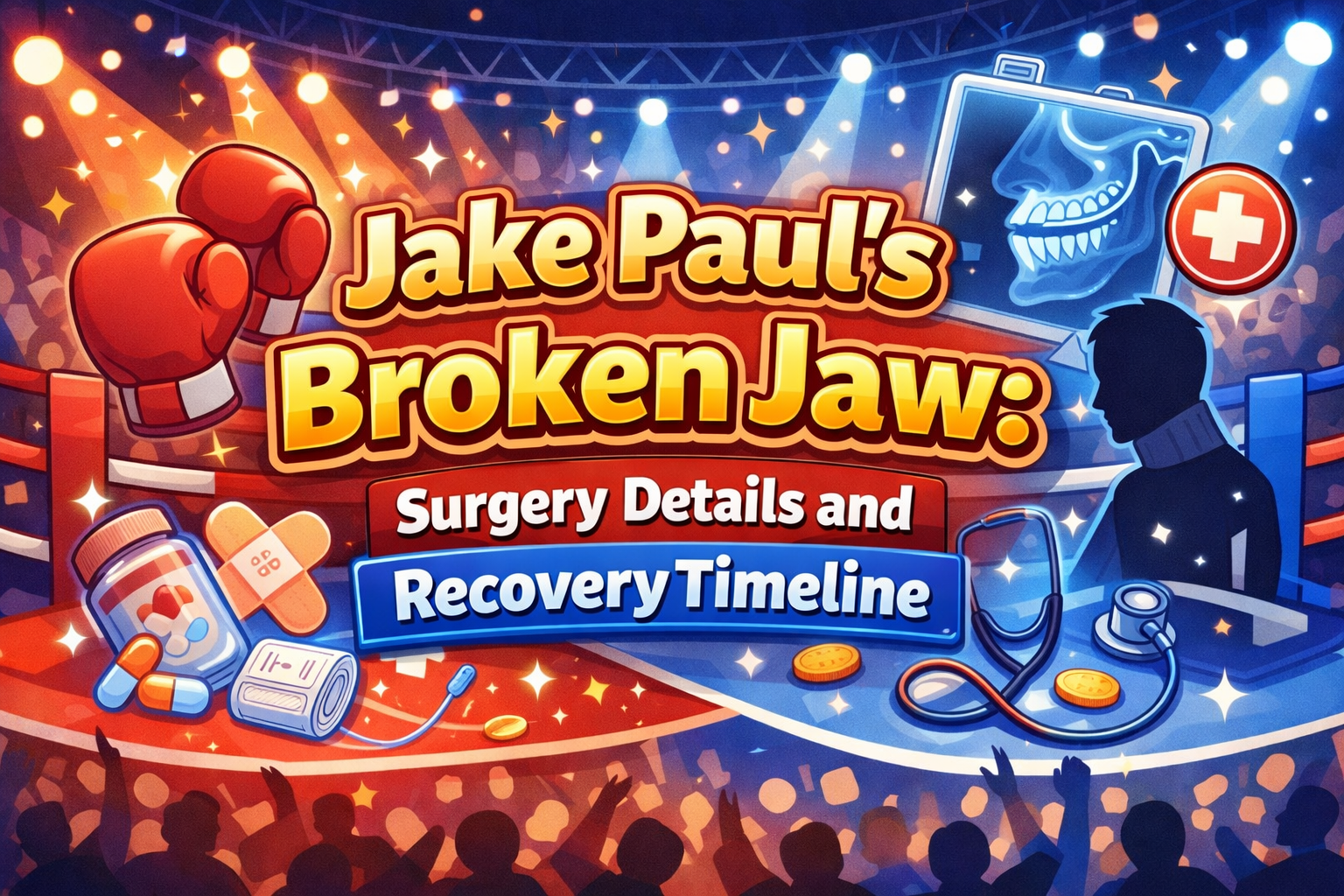
Jake Paul left the ring in Miami with more than just a loss on his record. In the days after his heavyweight bout with Anthony Joshua on December 19, 2025, Paul confirmed a “double broken jaw” and shared an X-ray that quickly went viral—fueling a surge of searches for Jake Paul broken jaw, Jake Paul hospital, and Jake Paul surgery update.
The good news, medically, is that jaw fractures in combat sports are serious but usually treatable—often with surgery, fixation hardware (like plates), diet restrictions, and a carefully staged return to training. The less comfortable truth is that recovery is rarely linear: swelling, pain, bite changes, and nutritional challenges can linger long after the first “I’m out of surgery” Instagram post.
Below is the most complete, evidence-based breakdown of what happened, what Paul has said publicly, what reputable outlets have reported, and what typical mandibular fracture rehab looks like—week by week—so readers can understand the injury beyond the headlines.
If you’re also tracking how injuries reshape fight markets, the boxing odds conversation tends to shift dramatically after medical updates; many fans follow line movement across platforms ranging from major sportsbooks to crypto-based options like TrustDice and dedicated sports betting hubs.
What happened to Jake Paul’s jaw in the Joshua fight?
Paul fought Joshua in Miami in a Netflix-streamed event. After the stoppage, reports quickly circulated that Paul was dealing with a jaw injury, which Paul later confirmed publicly by posting imaging and describing the damage as a double fracture.
The viral X-ray and “double broken jaw” post
Multiple reputable outlets reported that Paul shared an X-ray and wrote “Double broken jaw,” a post that helped drive the spike in Jake Paul x-ray broken jaw queries.
Was he hospitalized right away?
ESPN reported that Paul drove himself to the hospital after the fight, citing MVP executive Nakisa Bidarian.
Sky Sports also reported Paul was taken to hospital following the injury.
This matters because a suspected jaw fracture after a knockout isn’t just about the jaw—it can be associated with concussion concerns, airway issues, dental trauma, and facial swelling that complicates assessment.
Jake Paul surgery update: what was done?
The clearest surgery details come from Paul’s own post-surgery update as covered by People.com and echoed in major sports reporting.
Titanium plates and dental work
According to People.com, Paul said he underwent surgery for his broken jaw with two titanium plates inserted and that several teeth were removed, describing “lots of pain.”
CBS Sports also reported he underwent surgery and referenced the post-op update about being on liquids.
Those details align with how surgeons commonly manage more significant mandibular fractures: open reduction and internal fixation (ORIF)—repositioning the bone and stabilizing it with plates and screws—sometimes alongside dental management if fracture lines involve tooth roots or damaged teeth.
Liquid diet (initial restriction)
People.com reported Paul said he’d be limited to a liquid diet for 7 days.
That is consistent with many post-op protocols that begin with liquids and then progress to “no-chew” or soft diets depending on fixation stability, swelling, pain, and bite alignment. (Some oral surgery instructions advise liquids longer in wired or tightly immobilized cases, but protocols vary by surgeon and fracture pattern.)
If you’re curious how fight-week narratives can swing betting behavior—especially when a medical update drops midweek—guides like Inside the Ring and the Blockchain: Crypto Betting Meets Boxing in 2025 offer a useful lens for how modern fight audiences react in real time.
How bad is Jake Paul’s injury? Understanding a “double mandibular fracture”
A “broken jaw” typically means a mandibular fracture, which can occur at multiple sites (chin area, body, angle, ramus, condyle). “Double” often implies two fracture lines, which may happen when the jaw breaks in one place and the force creates another break on the opposite side.
What makes jaw fractures feel dramatic isn’t only the bone injury—it’s everything connected to it:
- Bite alignment (occlusion): even a small shift can make chewing painful or impossible.
- Dental trauma: chipped, loosened, or fractured teeth are common.
- Nerve symptoms: numbness in the lower lip or chin can occur if the inferior alveolar nerve is irritated or injured.
- Infection risk: the mouth isn’t sterile; fractures involving the tooth-bearing portion of the jaw require careful antibiotic and hygiene planning.
A key recovery principle from UK hospital guidance is that even with plates and screws, it still takes about 6 weeks for the jaw to heal completely, and reinjury risk remains high during that window.
Recovery time: how long does it take to recover from a broken jaw in boxing?
This is the question behind almost every spike query: Jake Paul recovery time, how long to recover from broken jaw boxing, and will Jake Paul fight again after jaw break.
The broad medical timeline (bone healing vs. fight readiness)
- Bone healing (typical): around 6 weeks is a common benchmark cited in patient guidance for mandibular fractures.
- Return to contact risk: many post-op instructions advise avoiding contact sports for 6–8 weeks (or more), depending on severity and surgeon preference.
- Early return in pros (select cases): published sports medicine literature suggests earlier return (<6 weeks) can be achievable for some athletes after maxillofacial fractures, often with protection and careful risk assessment.
What Paul’s team has said publicly
ESPN quoted MVP’s Nakisa Bidarian saying broken jaws are common in combat sports and suggesting a 4–6 week recovery window.
That estimate can make sense for “functional recovery” (swelling down, pain controlled, basic training resumed). But “cleared for sparring” and “safe to take a punch” are different milestones.
Jake Paul’s recovery timeline: a practical week-by-week guide
Because real rehab varies by fracture type and surgery, the best way to understand Paul’s path is to map a typical mandibular fracture recovery timeline—then flag what can speed it up or slow it down.
Key medical anchors in that table come straight from widely used patient guidance: the jaw is often “still weak” for about 6 weeks, and contact sports should be avoided during healing.
Liquid diet recovery: what “no chewing” really means
Paul’s liquid diet comment (reported by People.com) fits the first phase of many post-op plans.
But jaw fracture diets are often a progression, not a single setting:
- Liquid diet: smoothies, broths, protein shakes, meal replacement drinks (high calories help healing).
- No-chew / blenderized foods: yogurt, purees, soups thickened for nutrition.
- Soft diet: scrambled eggs, mashed foods, pasta—only when cleared.
- Normal diet: usually after several weeks and only if bite and stability are good.
UK hospital diet guidance for jaw surgery often recommends a soft diet that needs very little chewing for at least 6 weeks after certain jaw procedures.
And some oral surgery instructions for jaw fracture repair warn that chewing can create bone motion that interferes with healing, sometimes recommending liquid or no-chew phases for several weeks depending on immobilization.
For an athlete, nutrition becomes the hidden battle: protein intake, calories, micronutrients, and hydration all matter for tissue repair—especially if weight management is part of the sport.
Titanium plates in the jaw: do they stay forever?
Fans searching Jake Paul titanium plates jaw usually want one simple answer: Are the plates permanent?
Often, yes—plates can remain indefinitely if they’re not causing problems. Some are removed later if they irritate tissue, become infected, or interfere with dental plans. The decision depends on:
- plate location and size
- symptoms (pain, cold sensitivity, palpable hardware)
- infection history
- future surgeries (dental implants, orthognathic work)
Because Paul specifically referenced titanium plates (via People.com’s coverage), this is a realistic long-term consideration for him—even after he “feels fine.”
Jake Paul teeth removed surgery: why would teeth be taken out?
People.com reported Paul said “some teeth” were removed during surgery.
In mandibular fractures, teeth may be removed if they are:
- broken beyond repair
- loosened and unstable in the fracture line
- infected or likely to complicate healing
- obstructing proper reduction of the fracture
Dental trauma also explains why “jaw break” recoveries can take longer than bone healing alone—replacing teeth, managing nerve symptoms, and restoring bite function can take months.
Jake Paul medical suspension: 45 days, 60 days, and what it really means
One of the most searched injury-adjacent phrases is Jake Paul 45 day suspension. Suspensions after knockouts are common, but the exact duration depends on the sanctioning jurisdiction and the bout outcome.
Why “45 days” shows up so often
The Association of Boxing Commissions and Combative Sports (ABC) publishes minimum medical requirements that list an automatic suspension of 45 days for a KO/TKO from head shots (with additional “no sparring” guidance).
So “45 days” is a widely repeated baseline standard in the U.S. regulatory ecosystem.
Why reports also say 60 days
Some reporting has described Florida’s approach to KO-related rest periods as 60 days (often framed as “minimum 60 days” after a KO). For example, talkSPORT referenced a 60-day suspension after the Joshua KO.
In practice, commissions can extend suspensions based on injury severity—especially with facial fractures—until a doctor clears the fighter.
What it means for Paul
A suspension is not just “no fights.” It often implies:
- no sparring for a set period
- medical follow-up documentation required
- clearance timing tied to fracture healing and concussion screening
If you want a primer on how these developments ripple into wagering markets—especially when next-opponent speculation starts immediately—resources like Boxing Betting: Master the Art of Wagering on the Greatest Fights explain why injury news changes pricing faster than most fans expect.
Can boxers come back from a broken jaw?
Yes—fighters come back from jaw fractures all the time. A broken jaw is terrifying, painful, and disruptive, but it’s generally not career-ending if properly treated and rehabbed. The variables that matter most are:
- fracture complexity and displacement
- whether the joint area (condyle) is involved
- infection or delayed union
- bite alignment issues
- nerve symptoms
- repeat trauma risk (taking another shot too soon)
Sports medicine literature on facial fractures suggests that, with appropriate management, return to sport can occur earlier than many assume in select professional cases—though risk assessment is crucial.
That said, “return to training” is not “return to taking heavyweight right hands.” Even after bone union, confidence and protective instincts can affect performance.
Famous boxers who broke their jaw: why comparisons are tricky
Searchers often want a list of “famous boxers who broke their jaw” as proof that Paul can return. Many elite fighters have suffered facial fractures over the years, but timelines vary because:
- some fractures were treated with wiring vs plates
- some fighters took extended layoffs to avoid reinjury
- some returned quickly and re-broke the area
- modern plating can stabilize fractures better than older methods, but doesn’t eliminate impact risk
The better takeaway isn’t “X returned in Y weeks.” It’s that combat sports returns are negotiated between:
- medical clearance
- promoter timelines
- athlete psychology
- training camp quality
- risk tolerance
For fans who follow both boxing and MMA injury cycles, the cadence can feel similar: an injury update hits, a return rumor leaks, and odds start to appear. Multi-discipline readers often compare how markets behave across boxing and MMA fight lines in places like the mixed martial arts section.
Will Jake Paul fight again after a jaw break?
Paul’s public tone has been defiant and forward-looking, and coverage noted he even floated ambitious callouts while injured.
Medically, the question isn’t “can he fight again?” It’s “how soon is smart?” A reasonable, safety-first framework looks like this:
- Weeks 0–6: prioritize healing, bite alignment, nutrition, and dental stabilization
- Weeks 6–8: consider non-contact training and technical work
- Weeks 8–12: evaluate return to sparring intensity based on imaging, symptoms, and surgeon clearance
- Beyond 12 weeks: more typical window for full-contact confidence, especially after a double fracture (case dependent)
If Paul’s camp repeats the 4–6 week messaging, that likely refers to baseline fracture healing and functional improvement, not necessarily the safest time to be hit again.
What fans should watch for in future updates
If you’re following Jake Paul surgery update and Jake Paul medical update December 2025, the most meaningful signals aren’t vague “feeling better” captions. Look for:
- Confirmation of fracture type and location (if ever disclosed)
- Imaging follow-ups (CT or repeat X-rays)
- Bite/occlusion status (“my bite feels normal again” is a big deal)
- Numbness reports (chin/lip sensation)
- Clearance language from a surgeon or commission doctor
- Diet progression (liquids → soft foods → normal chew)
People.com’s reporting about plates and dental removal gives a strong hint this wasn’t a minor crack—it was significant enough to require ORIF-level stabilization.
FAQ
What happened to Jake Paul’s jaw?
He said his jaw was broken in two places and shared an X-ray, widely reported after the Joshua fight.
Did Jake Paul have surgery?
Yes. Coverage of Paul’s own update reported surgery that included two titanium plates and removal of several teeth.
How long will Jake Paul be out?
A common bone-healing benchmark for mandibular fractures is around 6 weeks, while many protocols advise avoiding contact sports for 6–8 weeks or longer depending on case severity.
ESPN also quoted Paul’s team suggesting 4–6 weeks as a recovery window in general terms.
What does a “45-day suspension” mean?
The ABC’s minimum medical requirements list 45 days as an automatic suspension for KO/TKO from head shots (plus “no sparring” guidance), but state commissions can apply different durations (often longer) and require medical clearance.
Conclusion
Jake Paul’s broken jaw isn’t internet rumor—it’s an injury he confirmed publicly, backed by widespread reporting and his own post-surgery update describing titanium plates, teeth removal, and an initial liquid diet period.
The most realistic recovery lens is to separate bone healing from fight readiness. Patient guidance commonly points to about 6 weeks for mandibular healing, while contact-sport return often falls closer to 6–12 weeks depending on stability and clearance.
Paul may feel dramatically better in a month, but the critical question is whether the bone—and his bite—are ready for impact again.
As the next updates arrive, the best indicators will be clinical: diet progression, bite function, imaging follow-up, and formal clearance language. And as always in modern boxing, injury news won’t just drive searches—it will shape scheduling, matchmaking, and the betting market chatter fans track across platforms like TrustDice and its boxing betting section.