






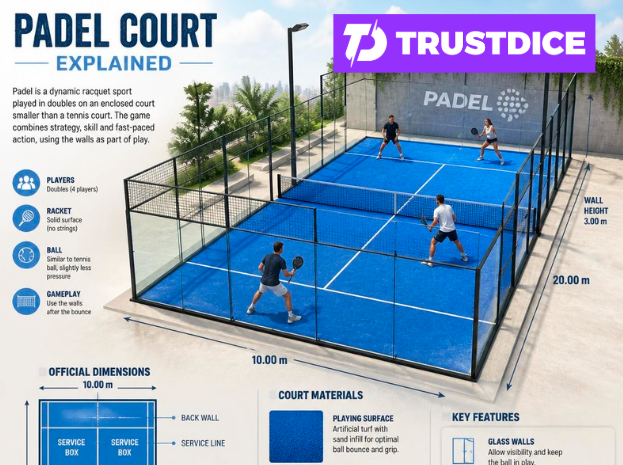
A padel court may look like a compact tennis court inside a glass cage, but every line, wall, opening, and section of fencing has a specific purpose. The enclosure is not simply there to keep the ball nearby. It actively shapes rallies, creates defensive rebounds, and gives padel its distinctive tactical identity.
Understanding the court helps beginners read the game more clearly. Once you know where the service lines sit, how the glass differs from the metal mesh, and why teams compete for the net, professional rallies begin to look far less chaotic.
Quick court guide 🎾
An official padel court measures 20 metres long and 10 metres wide internally. A net divides it into two equal halves, while glass or solid walls and metal fencing completely enclose the playing area.
Official Padel Court Dimensions
Under the International Padel Federation’s Rules of Padel, the internal playing area is a rectangle measuring 20 by 10 metres, with a permitted tolerance of 0.5%. The net divides this rectangle into two symmetrical 10-by-10-metre halves.
A service line is positioned 6.95 metres from the net on each side. The central service line divides the space between the net and service line into two equal service boxes and extends at least 20 centimetres beyond the service line. Court markings are five centimetres wide and should visibly contrast with the surface.
| Court Element | Official Measurement | Purpose |
|---|---|---|
| Total playing area | 20 m × 10 m | Creates two equal team areas |
| Distance from net to service line | 6.95 m | Defines the service boxes and defensive zone |
| Line width | 5 cm | Marks service boundaries |
| Minimum unobstructed height | 6 m | Allows high lobs and overhead play |
| Suggested height for new facilities | 8 m | Provides additional clearance for competitive play |
The free height above the court matters more than many first-time players expect. Padel teams regularly use high defensive lobs to force opponents away from the net. A low ceiling, hanging light, or structural beam can disrupt one of the sport’s most important tactical shots.
Net Height and Construction
The net stretches across the full 10-metre width of the court. It stands 0.88 metres high at the centre and rises slightly to 0.92 metres at both ends. This subtle difference makes the centre the lowest and statistically safest place for many controlled returns.
The mesh must be narrow enough to prevent a ball from passing through it. It should fill the area between the posts and surface without leaving side gaps, although it must not be pulled completely rigid. The posts may be circular or square, but their exposed edges must be rounded for player safety.
Tactical insight ⚡
The centre of the net is four centimetres lower than the ends. When defending under pressure, a controlled ball through the middle offers more clearance and can create hesitation between the opposing partners.
How the Glass Walls Shape the Game
The back of each court is enclosed to a total height of four metres. The lower three metres consist of a wall—usually transparent glass on modern courts—while the upper metre is metal fencing.
Although glass is now strongly associated with padel, the official rules also permit suitable solid materials such as brick. Whatever material is used must provide a hard, smooth, consistent surface that produces a uniform ball rebound and remains safe when players make bodily contact with it.
The back glass creates additional defensive time. If an opponent’s shot bounces on your court and then reaches the wall, you may return it before the second floor bounce. Faster shots often travel deeper off the glass, while balls carrying less pace may fall close to the wall. Reading that rebound is a fundamental padel skill.
Glass and Metal Mesh Are Not Interchangeable
The metal fencing completes the enclosure, but it does not behave like glass. A ball striking the mesh after bouncing can remain in play during a rally, yet its rebound is less predictable. It may drop sharply, change direction, or lose most of its speed.
This difference explains why experienced attackers target corners where glass and fencing influence the ball’s path. A shot does not need enormous power to be difficult; an awkward rebound can be more valuable than raw speed.
| Feature | Glass or Solid Wall | Metal Fencing |
|---|---|---|
| Rebound | Generally smooth and predictable | Irregular and less predictable |
| Typical location | Back wall and end sections of the sides | Upper and central enclosure areas |
| Player response | Create space and read the rebound | Prepare for a shortened or angled bounce |
| Tactical use | Reliable defensive recovery | Creates uncertainty for defenders |
Side Walls and Court Openings
The side enclosure combines wall sections near both ends with metal mesh across the central area. The FIP rules allow approved variations in how those side walls are arranged, so not every regulation court looks perfectly identical. Some use stepped wall sections, while newer panoramic designs may use extended glass panels with fewer visually intrusive supports.
Entrances are located along one or both lateral sides and must be symmetrical relative to the centre. Courts may use one or two access openings on each equipped side, with or without doors. If doors are installed, their handles must remain outside so they do not create an internal collision hazard.
Some competition courts permit authorized out-of-court play. In these rallies, a player can leave through an opening and return a ball that has travelled beyond the enclosure. Suitable courts require two access points on each side plus a clear external safety area measuring at least three metres wide, four metres long, and three metres high.
Spectator tip 🎯
When a player runs through an open gate to retrieve a smash, it is not an improvised exception. Out-of-court recovery is permitted when the venue meets the required access and safety conditions.
What Is a Padel Court Surface Made From?
Official surfaces may be constructed from cement, synthetic material, or artificial grass, provided they produce a regular bounce. Green, blue, and terracotta are among the preferred colours, and the entire playing surface should use one consistent colour that contrasts with the walls.
Artificial grass is common because it can provide a practical balance of traction, comfort, and ball response. Sand may be distributed through the turf to stabilize the fibres and influence movement. The amount and visibility of that sand vary between courts, which is why the same shoes may feel secure at one club but excessively slippery or restrictive at another.
Surface speed also changes the character of a match. A faster court rewards quick reactions and compact volleys, whereas a slower surface can extend rallies and give defenders more time. Temperature, humidity, turf condition, and ball wear can further influence how the court plays.
Why Court Position Matters
The service lines do more than control serving. They also provide a useful reference for positioning. Defending teams usually operate behind them, where there is enough space to read rebounds from the back glass. Attacking teams generally try to establish themselves several steps from the net.
The central area is the transition zone. Remaining there for too long can be dangerous: players may be too far forward to use the back wall comfortably yet too far back to pressure opponents with volleys. Strong pairs move through this area decisively rather than treating it as a permanent position.
| Court Zone | Primary Role | Typical Shot |
|---|---|---|
| Back-court zone | Defense and rebound management | Lob or controlled groundstroke |
| Transition zone | Movement between attack and defense | Low approach or emergency volley |
| Net zone | Pressure and point construction | Volley, bandeja, or smash |
Reading the Court as a Padel Fan
Once you understand the layout, watch how each pair moves between the glass and the net. Court control is not determined by who stands closer to the centre; it comes from occupying the correct depth, protecting useful angles, and moving laterally with a partner.
This knowledge can also improve match research for fans using a bitcoin sportsbook. Indoor or outdoor conditions, court speed, ceiling clearance, and permission for out-of-court play can all affect how particular teams execute their preferred tactics.
Anyone exploring bitcoin betting should still treat these details as context rather than guarantees. Results remain uncertain, so set a fixed entertainment budget before visiting a bitcoin sportsbook and never chase losses.
Final Thoughts
A regulation padel court is a carefully designed playing system rather than a smaller tennis court with added walls. Its 20-by-10-metre footprint, low central net, service boxes, glass rebounds, metal fencing, and side openings each influence how points develop.
For beginners, the most useful lesson is that different zones demand different decisions. Defend behind the service line, use the glass to gain time, move quickly through the transition area, and attack with your partner near the net. Once the layout makes sense, padel’s unusual rebounds begin to feel tactical instead of random.