








Explore the touching story behind Rockstar Games granting early GTA 6 access to a fan in need. Discover why the human element in esports and gaming—prioritized by brands like TrustDice—matters more than any win-loss record.
The story didn’t begin under spotlights. It began with a restrained plea for help.
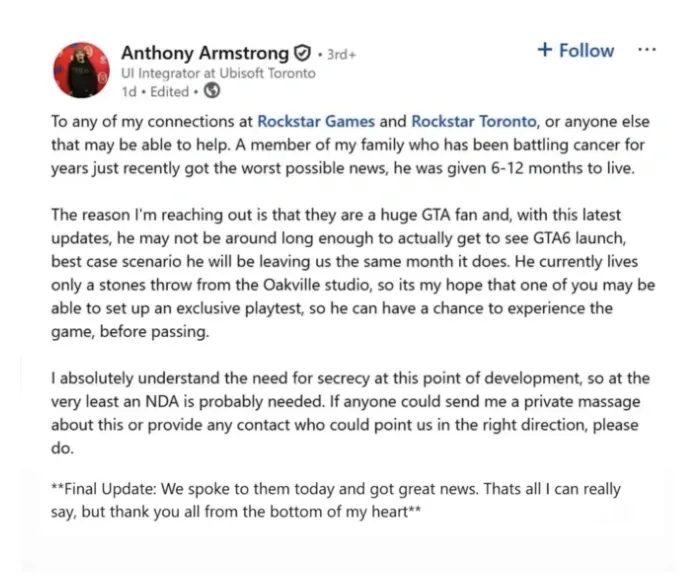
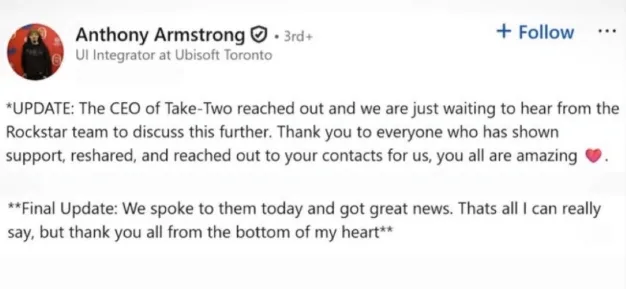
Anthony Armstrong, a UI designer at Ubisoft Toronto, posted something painfully “real” on LinkedIn: his family had been battling cancer for years, and doctors had recently said there might be only six to twelve months left. The tone was clinical, the timeline cold. But what he wrote next was unmistakably human—this family member was a devoted fan of the Grand Theft Auto series, and their deepest wish wasn’t to travel the world or complete some grand bucket list. It was simple: before time ran out, they wanted to play GTA 6 with their own hands.
On paper, it sounded impossible. GTA 6 is the kind of project guarded by secrecy so tight it can sway stock prices and public sentiment; one leak can trigger a cascade. Anthony knew that. So he laid out terms that were almost humble, yet meticulously serious: a private, personal session only; sign any form of strict NDA; no recording, no streaming, no sharing—zero risk of anything escaping. All he asked for was this one hour, this one chance, to push open a door the world had been waiting more than a decade to see.
Then came a detail that made the request feel both closer and more urgent: the family member lived nearly “next door” to Rockstar’s studio in Oakville, Canada. The post landed like a small stone dropped into the water of the game industry and player communities. Everyone understood how hard it would be. But people also understood something else: if no one was willing to even try, then the “emotional connection” the industry loves to talk about would be nothing more than marketing copy.
A few days later, Anthony posted an update. No long explanation—just one sentence:
Beyond the Rules: Why Rockstar Said "Yes"
“Good news: we did it.”
Rockstar said yes. They truly arranged early access to GTA 6 for this player, fulfilling a final wish.
In that moment, many people realized the weight of the decision wasn’t about what was played early—it was about what Rockstar chose to place first. Inside a system built on rules, secrecy, and risk control, they allowed “a person” to come before “the rules” for once. It wasn’t a victory of process; it was a decision of values—making room for softness inside the hardest machinery of business.
And it wasn’t the first time.
Before Red Dead Redemption 2 launched, Rockstar made a similar exception for a Dutch fan named Jurian who was living with neurofibromatosis and might not survive until release. His father reached out. Rockstar sent two staff members to his home and handed him a private playable build. No livestream. No leaks. No spectacle. Just one afternoon—his own Western time, given back to him before time could take it away.
Most people talk about GTA 6 in terms of waiting: waiting for announcements, trailers, gameplay, some future date still out of reach. But for some, “waiting” isn’t a mood—it’s a cost. Sometimes, it’s the cost of life itself. And when Rockstar pressed that “confirm” button early, it wasn’t granting privilege so much as acknowledging something important: video games are not only products. They are vessels of emotion between people—one of the few modern things that can soften regret, even slightly.
That is what it means for video games to be alive. And it’s also much closer to the true power of esports.
The Human Meta: Beyond the Win-Loss Record
Esports Betting is often misunderstood as an industry of “faster, stronger, win at all costs.” But its most moving part isn’t the win-loss record—it’s the shared experience behind it: a team clawing back from the bottom; a rookie’s trembling hands before their first decisive play; a comeback so dramatic the entire venue rises as one; and even in defeat, the rare moment when someone still applauds you—because they saw you, and they understood what it took to be there.
What makes people stay in games and esports isn’t just balance patches, numbers, or the current meta. It’s the authenticity of participation: you invested time, emotion, pride, and love—and the world, in some way, responded.
So when we talk about “the charm of games,” we’re not praising technology or scale. We’re praising something rarer: the ability for different people to meet under the same rules, for strangers to become close through a shared passion, and for someone—even at the hardest point of life—to still hold a chapter worth keeping, a level of their own story that feels complete.
More Than a Game, A World Worth Loving
That’s why if a brand like TrustDice wants to move in this direction, the goal shouldn’t simply be “more excitement” or “more noise.” It should be more humanity: greater respect for player experience, deeper care for community trust, stronger commitment to fairness and transparency, and a willingness to deliver real value to real people. To make every participation feel like more than a transaction—and every match more than a result—so that what remains is something worth remembering.
When an industry is willing, at a critical moment, to place people back at the center, video games stop being mere spectacle on a screen. They become a genuine light in someone’s life. For most, that light is joy. For some, it may be the last wish on their list—and any world that can hold that wish with care is a world truly worthy of being loved.