







Loot Boxes, Skin Liquidity, and the Billion-Dollar Shadow Economy of CS2 Betting
The Billion-Dollar "Money Printing Machine" Under Fire
In the autumn of 2023, the gaming world witnessed a financial phenomenon that blurred the lines between digital entertainment and high-stakes finance. Shortly after the transition from Counter-Strike: Global Offensive to Counter-Strike 2 (CS2), reports indicated that Valve earned approximately $40 million from loot box openings in a mere 40 minutes. While the player base celebrated the new engine, economists and regulators saw something different: a "money printing machine" operating with the efficiency of a Las Vegas casino, but without the corresponding oversight.
The scale of this economy is staggering. In October 2023, a single internal policy change by Valve regarding item trade-ability—imposing a 7-day trade lock on certain items—sent shockwaves through the virtual market, causing an estimated $2.4 billion in asset value to evaporate almost instantly. This level of volatility mirrors high-stakes stock exchanges or cryptocurrency crashes, yet it exists within the ecosystem of a tactical first-person shooter.
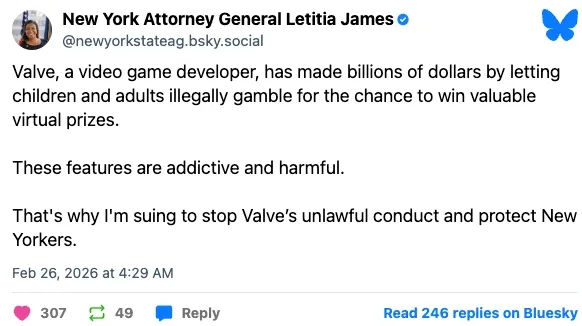
Today, the "Wild West" era of CS2 is facing its most significant legal reckoning. Recently, the State of New York filed a landmark lawsuit against Valve, alleging that the loot box mechanics in CS2 and DOTA 2 constitute illegal, unlicensed gambling. The summons highlights a market valuation in the billions and demands full refunds for players alongside triple damages. With Brazil also implementing a strict ban on loot boxes for minors starting in March 2026, the question is no longer if the industry will be regulated, but how the line between gaming and gambling will be redrawn.
The Reality of the Stakes: From Million-Dollar Trades to Integrity Scandals
To understand why regulators are so alarmed, one must look beyond the code and at the staggering real-world consequences of this economy. The "value" of CS2 items is no longer theoretical; it is a high-end commodity market. For instance, in 2024, the community witnessed a historic trade involving a Factory New StatTrak™ M9 Bayonet | Crimson Web, which changed hands for a valuation exceeding $1 million. When a single digital asset can buy a luxury estate, the argument that these are "just toys" loses all legal standing in the eyes of the DOJ.
However, where there is immense value, there is often corruption. The shadow of CS2 Betting is most visible in the infamous iBUYPOWER match-fixing scandal. In one of the darkest chapters of esports history, a premier North American team intentionally threw a match they were favored to win, simply to profit from high-value skins bet against them on third-party sites. Valve’s response was swift—a permanent ban for the players involved—but the incident proved that as long as skins remain a liquid "shadow currency," the integrity of the sport itself is at risk. More recently, the emergence of "Skin Baron" tycoons and private trading Discord servers—where hundreds of thousands of dollars move in minutes—demonstrates a financial ecosystem that has outpaced existing tax and anti-money laundering laws, making the New York lawsuit not just a possibility, but an inevitability.
1. Skin Gambling (Loot Boxes): The "Gateway" to the Ecosystem
To understand the legal controversy, one must first understand the "Skin." In CS2, a skin is a cosmetic overlay for a weapon. It provides no competitive advantage; a $50,000 "Factory New" Souvenir AWP Dragon Lore fires the same virtual bullets as the default green rifle. However, Valve’s genius—and its legal Achilles' heel—lies in the scarcity and liquidity of these items.
The RNG Trap
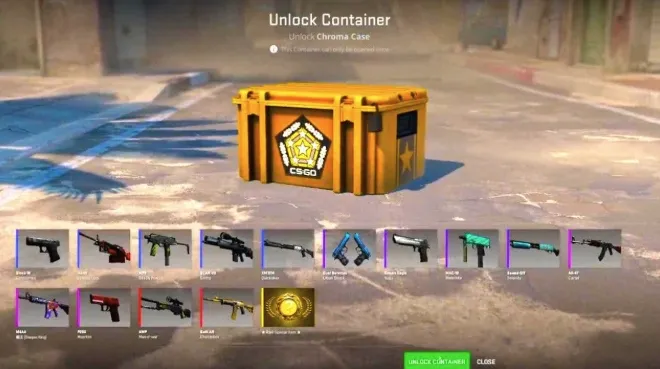
When a player pays $2.50 for a "Key" to open a "Case" (loot box), they enter a psychological loop designed by experts in behavioral economics. The outcome is determined by a Random Number Generator (RNG) with fixed odds. The vast majority of outcomes result in "Blue" (Mil-Spec) items worth a few cents. But there is a tantalizing, fractional percentage chance of hitting a "Gold"—a knife or pair of gloves that can be worth thousands of dollars.
The Financialization of the Skin
Unlike Fortnite or League of Legends, where skins are "account-bound" and have no resale value, Valve allows CS2 items to be traded between users. This creates a robust secondary market. Because skins can be sold for Steam Wallet funds and subsequently "cashed out" through third-party sites for real-world currency (USD, EUR, or Bitcoin), they have become a quasi-currency.
New York prosecutors argue that because these skins have a clear, fluctuates-by-the-second market value, opening a case is not "buying a toy"—it is "placing a bet." When the "prize" can be immediately converted into rent money, the psychological loop is identical to a slot machine. The $40 million Valve earned wasn't just from players wanting a "cool" gun; it was from a global audience chasing a "jackpot."
2. CS2 Betting: The Professionalization of the Wager
While "Skin Gambling" refers to the internal act of opening cases, CS2 Betting represents a separate, even more complex pillar of the ecosystem: Esports Wagering. CS2 is a premier esport, drawing millions of viewers to events like the PGL Majors. Parallel to this competitive scene is a massive, often unregulated betting industry.
Defining the Two Worlds
- Skin Betting: Using skins as "chips" on third-party websites to play roulette, coinflips, or "crash" games. These sites often use Valve’s API to automate deposits and withdrawals.
- The API Bridge: Turning Pixels into "Shadow Tokens"
- The most damning evidence in the "gambling" argument is the technical exploitation of Valve’s Steam Web API. On high-stakes betting platforms, skins are rarely treated as aesthetic items; instead, they are instantly liquidated into "Shadow Tokens" or site credits pegged to the U.S. Dollar.
- The API Bridge: Turning Pixels into "Shadow Tokens"
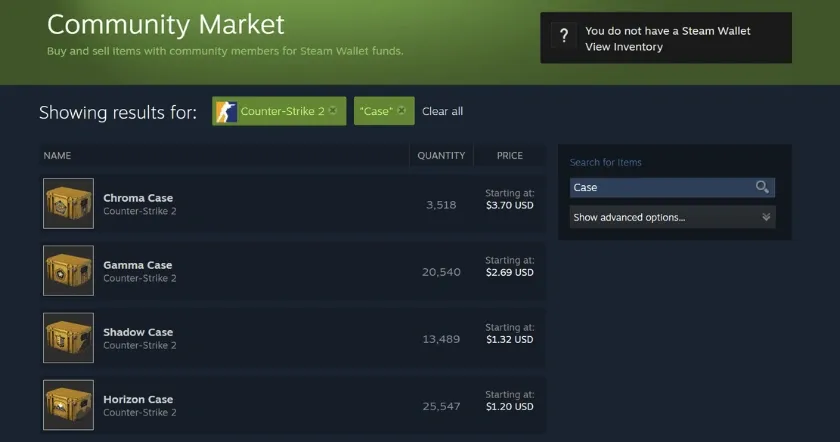
- For example, when a player "deposits" a Factory New AK-47 | Empress into a betting site, the platform uses an automated API bot to verify the item's existence and current market price. Within seconds, that skin disappears from the player's inventory and is converted into, say, $150 in site credits. These credits are the "chips" used for betting. This process effectively turns Valve’s trading system into a de facto banking wire. By using skins as a medium, these sites bypass traditional financial regulations (such as the Bank Secrecy Act), allowing users to gamble with an asset that has a direct USD peg without ever touching a credit card or bank account. This "Skin-to-Token" pipeline is exactly what regulators describe as a "unlicensed money transmission" system disguised as a video game.
- CS2 Betting: Traditional sports-style wagering on the outcome of professional matches (e.g., betting on Team Vitality to beat FaZe Clan).
The problem arises where these two worlds collide. Because Valve’s skins are liquid assets, many unregulated betting sites allow users to deposit skins to bypass traditional banking "Know Your Customer" (KYC) laws. This has historically allowed minors to gamble on professional matches using the skins they won or bought in-game.
The Integrity Crisis and Match-Fixing
The sheer volume of CS2 Betting has created a massive incentive for Match-Fixing. In the lower tiers of professional play, the potential profit from betting against oneself (spot-fixing or "throwing" a game) often outweighs the tournament prize pool. This "shadow economy" has forced Valve into a defensive crouch. While they have issued lifetime bans to players (famously the iBUYPOWER squad years ago), the New York lawsuit suggests that as long as Valve maintains the skin economy, they are the de facto "House" of a global gambling network.
3. The Legal Tug-of-War: Defining the Boundary
The global legal landscape is currently a patchwork of conflicting philosophies. The debate hinges on one question: Does a virtual item have "Value"?
The "No Value" Defense (The Valve/EA Stance)
Valve has historically argued that skins are just lines of code. They claim that since Steam does not officially allow "cashing out" to a bank account, the value stays within the "walled garden" of the game. This argument was successful in an Austrian court regarding EA Sports FC Ultimate Team packs, where the court ruled that since the cards couldn't be legally sold for cash, they weren't gambling.
The "Real World Value" Prosecution (The New York/Brazil Stance)
Regulators are becoming more tech-savvy. They point to the API (Application Programming Interface) keys that Valve provides, which third-party "cash-out" sites use to facilitate trades. The argument is: "If I can sell a virtual knife for $10,000 on a third-party site today, that knife has $10,000 in value." Under this logic, the "walled garden" is a myth.
Brazil’s recent move to ban loot boxes for those under 18 treats them like tobacco or alcohol. New York, however, is going for the jugular. By demanding triple damages, they are treating Valve as an illegal casino operator. If New York wins, every "Key" sold in the state for the last several years could be subject to a refund.
4. The Psychological Toll: The "Sunk Cost" and "Near-Miss"
Beyond the legal jargon lies the human element. CS2’s skin economy relies on the "Sunk Cost Fallacy" and "Near-Miss" psychology. When a player opens a case, the UI shows a spinning reel. Often, the reel stops just one millimeter away from a "Gold" item. Research shows that the human brain processes a "near-miss" similarly to a win, triggering a dopamine rush that encourages "just one more try."
For the adolescent brain, these triggers are particularly potent. The gamification of gambling—disguising a bet as a "fun loot box"—lowers the barrier to entry for compulsive behavior. This is why the CS2 Betting scene is so lucrative; it recruits "customers" through the game itself, transitioning them from "players" to "collectors" to "gamblers."
5. Future Outlook: A De-financialized CS2?
We are approaching a "Great Reset" for Counter-Strike 2. The pressure from New York and international regulators will likely force Valve into one of three paths:
- The "X-Ray" Model: Similar to the system in France, Valve may be forced to show players what is inside a case before they buy a key.
- Trade Locks and De-monetization: Valve could implement permanent trade-locks on all unboxed items. If an item cannot be traded, its "real-world value" drops to zero. This would kill CS2 Betting but destroy a $10 billion market.
- Strict Identity Verification: Implementing bank-level KYC for every Steam account to ensure no one under 18 can touch the market.
Jack's Views:
The "money printing machine" is at a crossroads. CS2 is a masterpiece of competitive design, but its financial shadow has grown too large for regulators to ignore. The New York lawsuit and the Brazilian ban are the first cracks in the dam. Whether CS2 remains a tactical shooter or continues as a "billion-dollar unregulated casino" will depend on if Valve can find a way to decouple the thrill of the game from the thrill of the bet.
As the legal tug-of-war continues, players should be wary. The items in your inventory are only worth what the law allows them to be. If the "gambling" line is drawn too strictly, the $2.4 billion "evaporation" of 2023 might just have been the opening act of a much larger crash.
🥚 Sharp eyes win again.Go claim it: EGGEST