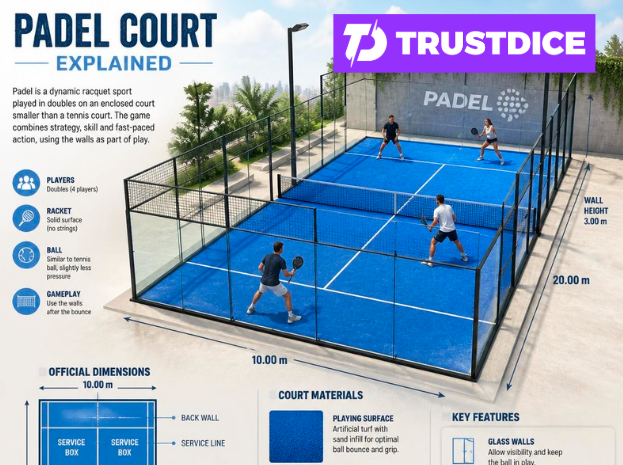








Padel is technically played by four individuals, but tactically it is a contest between two connected units. Strong partnerships defend the same spaces, advance at the same moment, and understand who should take the ball before it reaches the middle. Weak partnerships often look like two singles players sharing a court.
The most important doubles principle is simple: your position affects your partner. If one player charges forward while the other remains behind the service line, opponents can attack the diagonal gap between them. If both players move together, those easy spaces disappear.
Core partnership rule 🎯
Imagine that you and your partner are connected by a flexible rope. Move forward and backward together, maintain a practical distance between you, and shift laterally according to the ball’s position.
The Three Basic Team Positions
Most padel rallies move between three broad team states: defense near the back glass, transition through the middle, and attack near the net. Successful pairs recognize their current state and avoid occupying two different zones without a tactical reason.
| Team State | Typical Position | Primary Objective | Useful Shots |
|---|---|---|---|
| Defense | Both players behind the service line | Absorb pressure and create time | Lob, low drive, wall return |
| Transition | Moving through mid-court together | Reach the net without exposing gaps | Chiquita, controlled approach, low volley |
| Attack | Both players several steps from the net | Control angles and force a weak return | Volley, bandeja, víbora, smash |
Split positioning is normally the most dangerous arrangement. A player at the net may be passed through the middle, while the deeper partner must defend an unusually large area. The attacking player also has less confidence to pressure the ball because the team’s formation is already unstable.
Temporary separation is unavoidable during difficult rallies. The objective is not to remain perfectly level at every second, but to restore the team’s shared depth as quickly as possible.
How Partners Should Defend Together
When opponents control the net, both defenders usually operate behind the service line, where they have enough room to read shots after the back-glass rebound. Standing too far forward removes that time and can leave fast volleys trapped behind the body.
The defenders should move laterally in relation to the incoming ball. When the ball travels into your corner, you move toward it while your partner shifts toward the centre. Your partner is not abandoning the opposite side; they are closing the most immediate gap and preparing for a ball directed through the middle.
Defending a Ball in the Corner
The player closest to the corner reads the glass and handles the first defensive shot. The partner adopts a supporting position slightly closer to the centre. This creates coverage for a difficult rebound, a ball that changes direction, or a rushed return that lands short.
If both players remain glued to their individual halves, the middle becomes vulnerable. If both chase the same corner, the opposite side opens completely. Effective defense requires one player to engage with the ball while the other protects the next likely target.
Defensive reminder ⚡
Do not treat the centre line as a wall between partners. It divides the service boxes, but rallies require both players to adjust beyond their nominal halves when the situation demands it.
Who Takes the Ball Through the Middle?
Middle balls cause more confusion than technically difficult corner shots. Both players may hesitate because each expects the other to swing, or both may attack the same ball and collide. A partnership needs clear rules, but those rules should account for position, shot type, and available forehands.
In many situations, the player whose forehand covers the centre has an advantage. For two right-handed players, that is usually the player on the left side. Their forehand can attack through the middle, while the right-side player would need a backhand.
However, “forehand takes the middle” is not absolute. The player closer to the ball, the player already moving forward, or the player with the clearer angle may be the better choice. A high lob over one player should normally be handled by the partner who can move underneath it safely, rather than by someone reaching across at the last moment.
| Middle-Ball Situation | Likely Priority | Communication |
|---|---|---|
| Neutral groundstroke between partners | Player with the centre forehand | “Mine” or “yours” |
| Fast ball closer to one player | Nearest balanced player | Early ownership call |
| High lob over the centre | Player with the safer overhead angle | “Mine,” “leave,” or “switch” |
| Ball after an unpredictable wall rebound | Player with a clear view and contact point | Short, immediate call |
Make the call before the ball enters the hitting zone. Late communication is almost as disruptive as silence because a partner may already have started their swing.
Right-Side and Left-Side Roles
Padel positions are sometimes described as the right-side player and left-side player. These roles are tactical tendencies rather than permanent personality types, especially at recreational level.
A right-handed player on the right commonly uses a backhand through the centre. This role often rewards consistency, careful construction, reliable defense, and an ability to prepare opportunities for the partner. The right-side player still attacks, but may do so through controlled volleys and placement rather than covering every overhead.
A right-handed player on the left has a forehand and overheads closer to the middle. This can make the left side suitable for a more aggressive player who covers central lobs and looks for víboras or smashes. That player must avoid taking so much court that the partner becomes passive or uncertain.
A left-handed player can change the balance. When a left-hander plays on the right beside a right-hander on the left, both players have forehands and overheads toward the centre. This creates attacking potential, although the pair must communicate especially clearly to prevent collisions.
Partnership insight 🧠
Choose sides according to forehand coverage, overhead ability, confidence under pressure, and partnership chemistry—not merely because one player believes the left side is more prestigious.
How to Take Control of the Net
The net is padel’s primary attacking position because it allows players to contact the ball earlier, reduce their opponents’ reaction time, and create downward angles. Reaching the net does not guarantee control, however. Both partners must arrive in balance and preserve enough distance to react to a lob.
After serving, the server should move forward immediately to join the partner, who already begins near the net. The return team usually starts deeper because the receiver must allow the serve to bounce. A strong return can create an opportunity to advance later, but charging forward behind a weak ball simply gives the serving pair an easy target.
Advance Behind the Right Ball
A deep lob is the clearest transition signal. If it passes the opponents and forces them toward the back glass, both partners should move forward. A chiquita directed below net height can also create an opportunity because opponents may be forced to volley upward.
Watch the quality of your shot before committing. If a lob falls short, stay back and prepare to defend the overhead. Moving forward automatically after every lob can leave both players exposed to a smash or aggressive víbora.
Avoid Standing Directly on Top of the Net
Standing extremely close improves access to short volleys but makes lobs difficult to cover. A practical attacking position is usually several steps behind the net, adjusted according to the opponents’ contact point. Move closer when they are stretched or contacting below net height; drop slightly when they have time to prepare a lob.
| Opponent’s Situation | Net Pair’s Response | Reason |
|---|---|---|
| Opponent contacts below net height | Close forward together | A powerful downward reply is unlikely |
| Opponent has time under the ball | Prepare to retreat for a lob | The overhead space is under threat |
| Opponent is trapped in a corner | Shift toward that side while protecting the middle | Reduces their useful angles |
| Opponent drives from a balanced position | Hold a stable formation | Prevents unnecessary gaps |
How the Net Pair Moves Laterally
At the net, partners should shift in the direction of the ball. If the ball is played into the opponents’ right corner, the nearer net player covers the line and immediate angles. The partner moves toward the middle to reduce the central gap.
The far-side player should not remain beside the opposite fence. From that position, they protect a difficult cross-court target while surrendering the shorter and more dangerous middle route. The pair should resemble a compact defensive block that slides from side to side.
A useful spacing reference is that both players should be close enough to discourage a simple ball between them but not so close that one shot can pass outside both rackets. Exact spacing changes according to ball speed, court position, and each player’s reach.
Recovering After an Overhead
A deep lob often pushes one net player backward. Their partner must respond instead of watching from a fixed position. If the overhead player moves diagonally toward the centre, the partner should adjust to protect the newly exposed space.
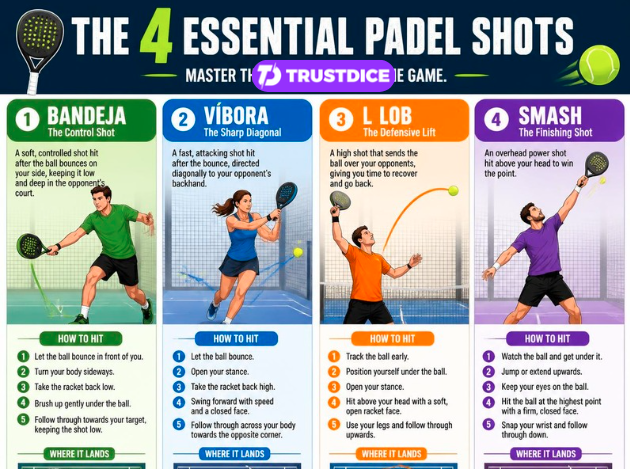
After a controlled bandeja, both players should recover the net together. The hitter moves forward after contact, while the partner maintains a balanced position rather than advancing alone. If the lob is too deep for a safe overhead, both players should retreat and rebuild from defense.
Overhead decision ⚡
Giving up the net is better than forcing a desperate overhead while falling backward. Retreat together, use the glass, and wait for another opportunity to advance.
Communication That Actually Helps
Useful communication is brief, early, and specific. Players should call ownership of shared balls, but they can also tell a partner what the opponents are doing when that partner turns toward the back glass.
Common calls include “mine,” “yours,” “leave,” “back,” and “switch.” Partners can also agree on simple descriptions such as “both back,” “one back,” or “at net.” The exact vocabulary matters less than consistency.
Communication should continue between points. Discuss whether opponents are targeting one side, whether lobs are consistently falling short, and which return direction is producing the strongest transition. Avoid turning every mistake into a technical lecture. One actionable observation is more useful than a long criticism during a match.
Five Partnership Mistakes to Avoid
1. Following the Ball Instead of the Formation
Players often stare at the shot and forget to recover. After contact, immediately return to the position required by your team’s formation.
2. Advancing Alone
A solo charge creates a diagonal gap and gives opponents two depths to attack. Signal the move and advance behind a strong shot together.
3. Protecting Only the Side Wall
The middle is usually a shorter and safer target for opponents. Shift with the ball instead of remaining permanently attached to your assigned half.
4. Taking Every Overhead
A strong attacking player may cover additional space, but excessive poaching destroys trust. Call early and allow your partner to play balls they can contact comfortably.
5. Blaming the Final Error
The last missed volley may not be the real cause of the lost point. A short lob, poor recovery, or unprotected middle could have created the problem several shots earlier.
A Simple Doubles Training Session
Begin with a shadow-movement drill in which both players shift forward, backward, and laterally without hitting a ball. This may feel basic, but it exposes spacing problems immediately.
Next, play a defense-versus-net exercise. The back pair attempts to use a lob or chiquita to advance, while the net pair tries to maintain its position with controlled volleys and bandejas. Award the defending team an additional point whenever both players successfully reach the net behind the same shot.
Finish with a middle-ball drill. Feed different heights and speeds between the partners, requiring an early verbal call before every contact. Include lobs so the pair must decide who takes the overhead and how the other player covers the open space.
Analysing Professional Padel Partnerships
When watching elite matches, follow the players rather than only the ball. Observe which partner covers central overheads, how the pair shifts when a defender enters the corner, and whether they recover the net after each bandeja. These patterns reveal more about partnership quality than isolated winners.
Fans researching matches through a bitcoin sportsbook can consider playing-side compatibility, recent partnership changes, preferred court conditions, and performance against left-handed combinations. A newly formed pair may possess excellent individual rankings but still struggle with spacing and middle-ball decisions.
That tactical research does not remove uncertainty from bitcoin betting. Form can change, injuries may affect movement, and close matches can turn on a few decisive points. Set a fixed entertainment budget before using a bitcoin sportsbook, and never chase previous losses.
Final Thoughts
Effective padel doubles strategy begins with coordinated movement. Defend behind the service line as a pair, protect the middle when the ball enters a corner, and advance only when a strong lob or low approach creates enough time. At the net, move laterally together and adjust your depth according to the opponents’ contact point.
Clear responsibilities make those movements easier. Decide who normally covers central balls, assign playing sides according to actual strengths, and use short calls before confusion develops. The strongest partnership is not necessarily the pair with the hardest smash. It is the pair that repeatedly occupies the right spaces, makes the same tactical decision, and behaves like one team throughout the rally.