







Climbing Competitive can feel confusing when one win gives big RR and the next barely moves your badge. This guide explains valorant ranks, RR, MMR, rank resets, Act Rank, party limits, and practical ways to improve without guessing.
Valorant Ranking System
- How To Play VALORANT Ranked Mode
- How Many Rank Tiers Are There In VALORANT?
- What Are The Differences Between All VALORANT Ranks?
- How Does The VALORANT Ranking System Work?
- Does Your Rank Reset In VALORANT?
- Does VALORANT Have Rank Decay?
- What Is VALORANT Act Rank?
- What Is The Latest VALORANT Rank Distribution?
- Which Ranks Can Play Together in VALORANT?
- How To Rank On Regional Leaderboards In VALORANT
- How To Rank Up Fast In VALORANT – Our Top Tips
How To Play VALORANT Ranked Mode
To unlock Competitive mode, you must reach Account Level 20. You can gain XP through Unrated, Swiftplay, Spike Rush, Deathmatch, Escalation, and missions. Once unlocked, Competitive becomes the main place where valorant ranks are earned and tested.
- Open VALORANT on PC.
- Click “Play.”
- Select the “Competitive” tab.
- Queue and complete your placement matches.
Quick tip 💡
Your first placements matter, but they do not define your entire climb. VALORANT also considers your hidden skill rating, recent match quality, and long-term performance trends.
How Many Rank Tiers Are There In VALORANT?
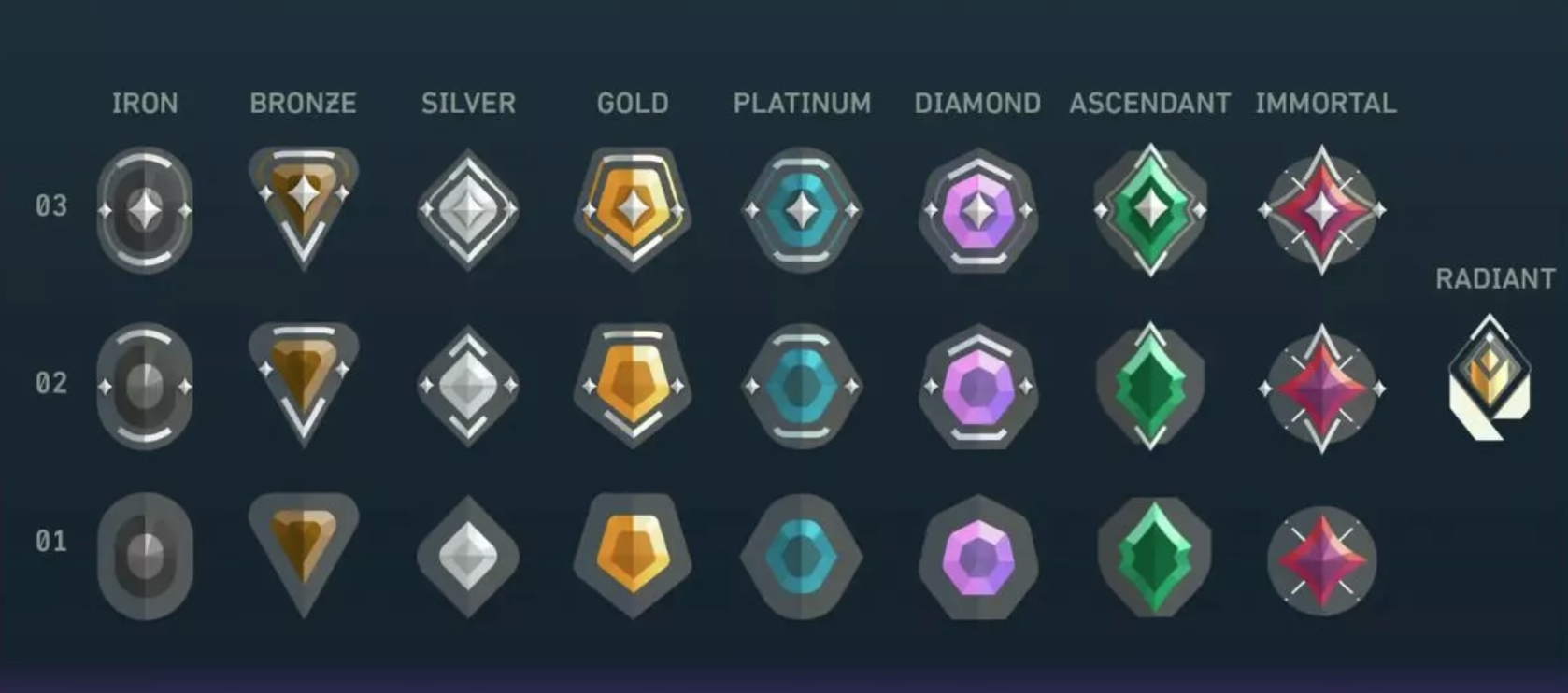
There are nine main valorant ranks: Iron, Bronze, Silver, Gold, Platinum, Diamond, Ascendant, Immortal, and Radiant. Most tiers have three divisions, with Tier 3 being the highest inside that rank. Radiant is different because it is reserved for the best players on each regional leaderboard.
| Rank Group | Divisions | General Skill Level |
|---|---|---|
| Iron–Silver | 1–3 | Learning mechanics, maps, and consistency |
| Gold–Diamond | 1–3 | Stronger aim, better teamwork, clearer strategy |
| Ascendant–Immortal | 1–3 | Advanced utility, timing, discipline, and adaptation |
| Radiant | Single tier | Elite regional leaderboard level |
The full order is Iron 1 through Iron 3, Bronze 1 through Bronze 3, Silver 1 through Silver 3, Gold 1 through Gold 3, Platinum 1 through Platinum 3, Diamond 1 through Diamond 3, Ascendant 1 through Ascendant 3, Immortal 1 through Immortal 3, and Radiant.
What Are The Differences Between All VALORANT Ranks?
The difference between valorant ranks is not only aim. Higher-ranked players usually make better decisions under pressure, trade more effectively, manage utility more efficiently, and understand when to fight or wait.
Iron
Iron players are usually still learning basic movement, crosshair placement, recoil control, and map awareness. The fastest improvement comes from practicing simple fundamentals instead of trying advanced tactics too early.
Bronze
Bronze players understand the game better but often struggle with consistency. They may win duels one round and lose easy fights the next. Better positioning and cleaner communication can create fast progress here.
Silver
Silver players usually have decent mechanics and know common map areas. The main issue is decision-making: rotating too late, over-peeking, or wasting utility before contact.
Gold
Gold players begin to show stronger structure. They can follow executes, hold angles, and coordinate with teammates, but overconfidence often leads to unnecessary deaths.
Platinum
Platinum players are more stable. They understand economy, map control, and role responsibility. To climb further, they need cleaner mid-round calls and fewer emotional mistakes.
Diamond
Diamond players usually have strong aim and solid game sense. The gap between Diamond and higher valorant ranks often comes down to discipline, utility timing, and adapting to enemy patterns.
Ascendant
Ascendant players know advanced setups, rotations, and team coordination. Small mistakes are punished quickly, so consistent decision-making becomes more important than raw aim alone.
Immortal
Immortal players combine strong mechanics with deep tactical knowledge. They read opponents quickly, punish weak utility, and understand how to convert small advantages into round wins.
Radiant
Radiant is the elite tier. Players at this level often perform near professional standards, with exceptional mechanics, prediction, communication, and mental control.

How Does The VALORANT Ranking System Work?
The system is built around two key ideas: visible Rank Rating and hidden Matchmaking Rating. RR shows your visible progress, while MMR estimates your real skill level behind the scenes. This is why two players in the same match can gain different RR.
Rank Rating (RR)
RR is the visible point system used to move through valorant ranks. For most ranks, you need 100 RR to promote. If your RR drops below zero, you risk demotion.
Wins usually increase RR, losses reduce it, and round difference can influence the amount. A clean 13–4 win often rewards more than a narrow 14–12 win. Individual performance can matter more for newer accounts, but teamwork and winning rounds remain the most reliable path upward.
Matchmaking Rating (MMR)
MMR is hidden and estimates your true skill. If your MMR is higher than your visible rank, you may gain more RR for wins and lose less for defeats. If your MMR is lower, climbing becomes slower because the system wants your visible badge to match your long-term performance.
Penalties
VALORANT penalizes behavior that damages match quality, including AFK behavior, queue dodging, toxicity, and intentional disruption. Penalties can include XP denial, queue restrictions, RR loss, or account bans.
Does Your Rank Reset In VALORANT?
Yes. VALORANT uses resets to keep Competitive fair and fresh. In the current season-based format, major resets happen at key seasonal points, while Act transitions may require recalibration. Your hidden MMR usually carries over, so you are not starting from zero.
This means your badge may drop, but the system still remembers your previous skill level. Players who perform well after reset often recover faster than expected.
Does VALORANT Have Rank Decay?
VALORANT does not use traditional visible rank decay for most players. If you stop playing, your badge does not simply disappear. However, inactivity can make your first matches back feel harder because the system needs fresh data to confirm your current form.
Practical advice ✅
After a long break, play warm-up games before Competitive. Returning directly to ranked often causes avoidable RR losses.
What Is VALORANT Act Rank?
Act Rank is a visual record of your best Competitive performance during an Act. It does not directly control matchmaking, but it shows your proven peak and consistency.
The Act Rank badge fills with triangles based on ranked wins. Higher-ranked wins replace lower-ranked ones, so the badge gradually reflects stronger achievements as you climb through valorant ranks.
What Is The Latest VALORANT Rank Distribution?
Most players sit in the middle and lower tiers, especially Bronze, Silver, and Gold. This is normal in competitive games because the ladder is designed like a pyramid: many players at the base, fewer players near the top.
| Rank Range | Player Type | What It Usually Means |
|---|---|---|
| Iron–Bronze | Developing players | Learning core mechanics and consistency |
| Silver–Gold | Average competitive base | Solid basics, inconsistent decisions |
| Platinum–Diamond | Above average | Better aim, teamwork, and map control |
| Ascendant+ | Highly skilled | Advanced game sense and discipline |
For players interested in match analysis, understanding valorant ranks also helps when evaluating team strength, player form, and market movement around esport betting.
Which Ranks Can Play Together in VALORANT?
VALORANT limits ranked parties to protect competitive balance. In smaller parties, players generally need to be close in rank. Five-stacks are more flexible, but large skill gaps can reduce RR gains.
VALORANT Ranked Mode Party Restrictions
| Your Rank | Common Eligible Party Range |
|---|---|
| Iron/Bronze | Iron, Bronze, Silver |
| Silver | Iron, Bronze, Silver, Gold |
| Gold | Silver, Gold, Platinum |
| Platinum | Gold, Platinum, Diamond |
| Diamond | Platinum, Diamond, Ascendant |
| Ascendant | Diamond, Ascendant, Immortal |
| Immortal/Radiant | Higher-rank restrictions apply |
If you queue with a wide rank gap, expect tougher matchmaking and possible RR reductions. For a serious climb, party with players who communicate well and understand similar valorant ranks.
How To Rank On Regional Leaderboards In VALORANT
To appear on a regional leaderboard, you generally need to reach Immortal or higher, play enough Competitive games during the Act, remain active, and keep your account in good standing.
- Reach Immortal rank or above.
- Play enough Competitive matches during the Act.
- Stay active so your leaderboard position remains valid.
- Avoid penalties, restrictions, or bans.
Leaderboard placement is heavily RR-based, which is why the top spots are usually dominated by Radiant players.
How To Rank Up Fast In VALORANT – Our Top Tips
Ranking up is not about playing endless games with no plan. The best climbers review mistakes, specialize in useful Agents, communicate clearly, and avoid tilt. The same discipline also helps viewers understand professional matches, whether they follow tournaments casually or place an esports bet.
Master The Agents
Choose a small Agent pool and learn it deeply. Know your utility lineups, common setups, retake options, and weak matchups. Mastery beats random variety.
Don’t Overthink It
Overthinking causes hesitation. Instead of changing everything after one bad match, identify one mistake at a time: poor crosshair placement, bad timing, weak communication, or unnecessary peeks.
Study Map Layouts
Map knowledge improves every part of your game. Learn common angles, rotation routes, spike plant zones, choke points, and post-plant positions. Strong map awareness helps you win rounds even when your aim is not perfect.
Final takeaway 🎯
If you want to climb valorant ranks, focus on repeatable habits: warm up properly, communicate early, trade teammates, manage utility, and review your losses honestly. For fans betting on esports, the same rank knowledge can also make match analysis more accurate and responsible.
FAQ
What is the fastest way to improve in VALORANT ranked?
Focus on crosshair placement, map awareness, utility timing, and communication. Playing fewer but higher-quality matches is usually better than grinding while tilted.
Why do I gain less RR than my teammates?
Your hidden MMR may be lower than your visible rank, or the system may be trying to align your rank with your long-term performance.
Are valorant ranks useful for esports analysis?
Yes. Rank knowledge helps explain player skill levels, team structure, and tactical expectations. It is also useful context for responsible esport betting research.